Mamie (2024) – CineParadis Revew
by Horea Hudin

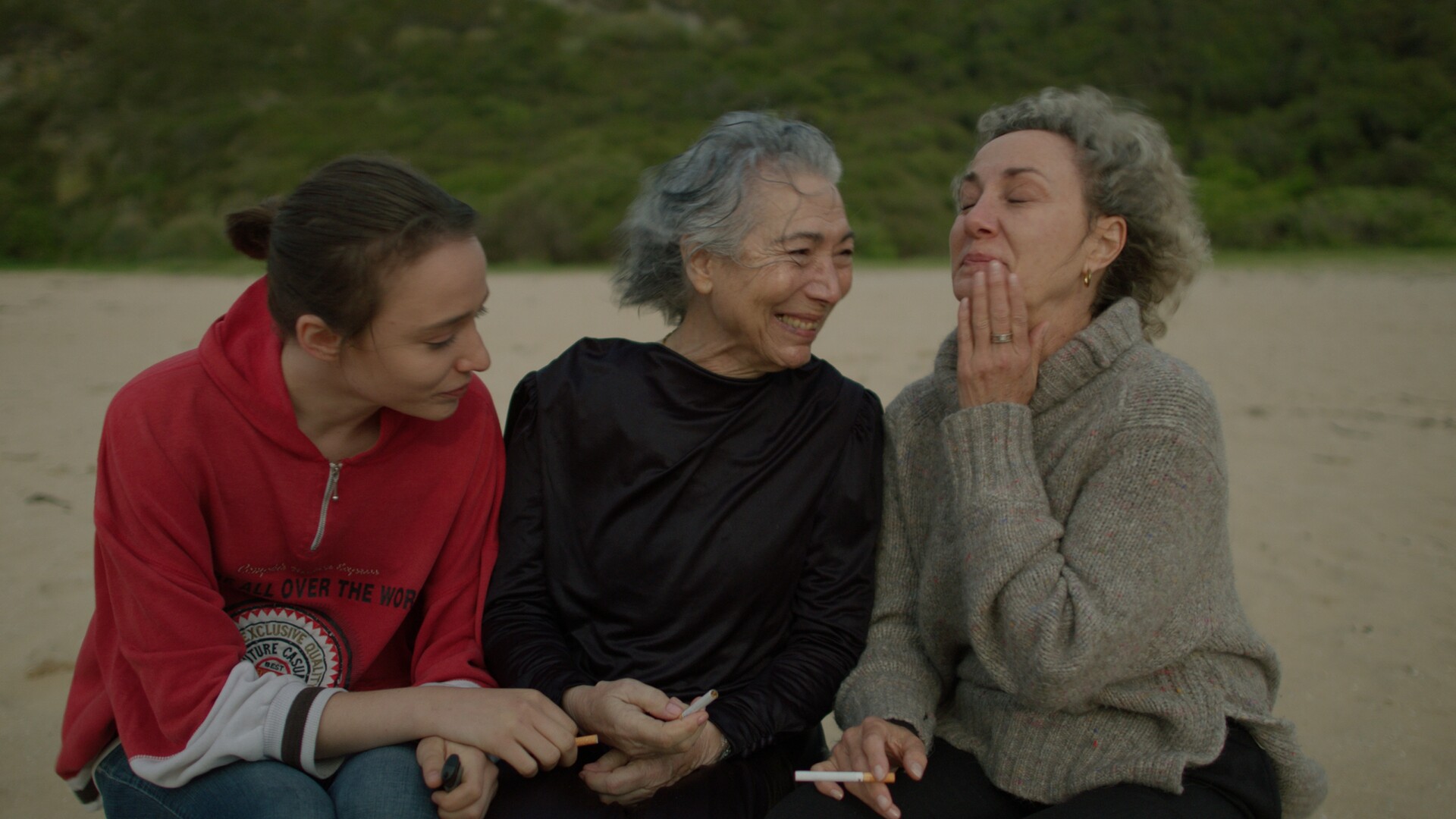
Standing on an empty beach on an overcast day, dressed in black funeral clothes, the grandmother of the matrilineal family prepares to meet her demise. Pedro Tamames’s short film Mamie, screened in competition at the Cinema Paradiso International Short Film Festival, is seemingly simple but has a complex underlying structure.
Mamie, the grandmother, Anne, the mother, and Carla, the daughter, are forced to reunite when the grandmother announces that she has decided she wants to die. This raises an important question: Who does the end of a life belong to: the individual alone, or also to those who remain? As the story progresses, themes of estrangement and hints of abusive behaviour come to light, making us reflect on the different points of view held by the three women.
The house Mamie lives in is filled with symbolic imagery that hints at a difficult past. A fitting example is a wood-carved bas-relief of a predatory bird about to kill a small songbird. There is also a turquoise-collared ceramic bull and an old toy. This works well as the camera repeatedly cuts from this imagery to an extreme close-up of Carla’s eyes while unsettling music plays. The ideas at work therefore hint at more than is apparent in the straightforward plot.
Scenes over coffee and dinner portray the conflict among the three women with deliberate subtlety, allowing their dynamics to emerge as the nuances of their conversations are expressed through small gestures of eating and drinking. One effective example is the dinner scene, where characters throw out verbal and emotional jabs, only for these to strike back in turn, almost like the three women are fighting their own reflections. The mood is shaped by progressively tighter shots, using depth of field and centring the characters in the frame to intensify the women’s emotions and draw the viewer into their minds. In conversations, Mamie is always placed between the two younger women, suggesting through her position that she acts as a bridge between mother and daughter. This is an excellent piece of visual language that makes the grandmother’s ultimatum feel even more dramatic. Another key aspect that relieves some of the accumulating tension is the natural dialogue, which contains some comic gems that take you by surprise.
Mamie’s frustrations take us further, exposing the fact that loving others means one cannot live entirely for oneself. This is exactly what tears Anne apart and makes her feel betrayed. She is shocked and deeply hurt that her mother wants to abandon them. Having a daughter of her own makes it even more difficult to relate to Mamie’s need for freedom. In contrast, the grandmother feels she has been living for other people, and her need for freedom is in opposition to family responsibility. This poses an interesting paradox: Perhaps family is a kind of prison, but one whose walls are made of attachment, responsibility and love, without which freedom might feel empty.
Carla and Anne have different points of view. Carla is young and dissatisfied with her studies, longing to be free, whereas Anne is middle-aged and wants to keep the family together, feeling a responsibility towards Carla and Mamie. Thus, they react very differently in accordance with their inner desires. One of the short film’s strengths is that it shows that no one is truly right. People have always strived for freedom. It is something that makes us human.
In conclusion, the film makes us think about how family can become overwhelming, even confining, while also suggesting that simply abandoning relationships or choosing, like Mamie, to end one’s life is not a true solution to the problem. Complete freedom comes into conflict with our need for belonging, responsibility and meaning. All in all, Mamie achieves strong emotional engagement, as the grandmother’s struggles are easy to identify with. The classical memento mori theme leads to a believable plot and characters who pose important questions in an original way.