ELSINORE: When kindness becomes an act of resistance
Simon Stone’s moving portrait of actor Ian Charleson is a reminder that art, love and human connection can survive even when the world around us seems to have forgotten their value.

The power of a gentle soul
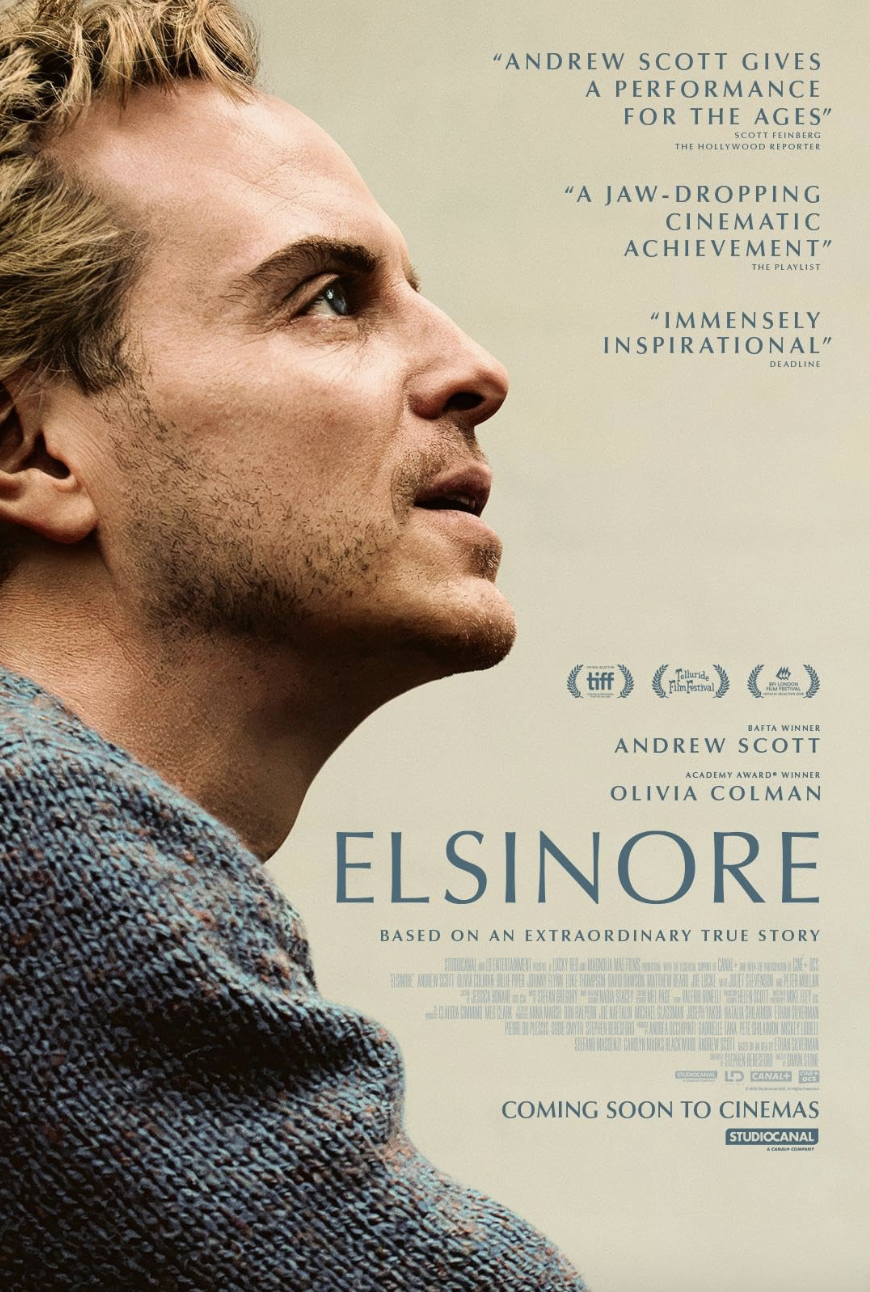
Some performances stay with you long after the credits have rolled. In Elsinore, Andrew Scott delivers one of those performances. His face, his expressions and the smallest shifts in emotion carry a remarkable weight, making Ian Charleson feel less like a character being portrayed and more like a person we have somehow come to know.
Set in 1980s London, during the early years of the AIDS crisis, Simon Stone's film tells the true story of an actor whose greatest artistic challenge comes at a time when his own health is failing. But beyond the illness, the prejudice and the approaching end, Elsinore is a story about love and the community we create around ourselves.
What makes Ian so compelling is not simply his courage, but his gentleness. He remains polite, warm and generous, even when the world does not always return the same kindness. His friends become his family, and their shared affection creates a space in which he can continue to live, work and dream.
I particularly loved that Ian is an actor. Perhaps this is a personal connection, but I recognise something familiar in the world he inhabits. Acting is a profession built around human exchange, emotions, vulnerability, laughter and, yes, hugs. It is a world that still believes in the importance of feeling. And what is especially moving is watching how Ian's way of being gradually influences the people around him, even those who initially seem unable to understand him.
Shakespeare never stops speaking to us
There is something profoundly beautiful about watching classical theatre find such a natural place within a contemporary film. The Shakespearean language, the rehearsals and the preparation for Hamlet are not simply references to an actor's professional life. They become an essential part of the story.
Shakespeare's words remain painfully relevant because the human condition has not changed as much as we would like to believe. The struggle with mortality, ambition, love, fear and the meaning of existence continues to define us.
The theatre sequences are particularly well integrated into the film. They are beautifully captured, with a rhythm that allows the audience to settle into the performances, listen and experience the emotional weight of the words. Cinematographer Mike Eley captures these moments with sensitivity, while editor Valerio Bonelli gives the film a natural tempo, never allowing the technical execution to distract from the story.
This is also where Simon Stone's direction deserves particular recognition. His approach is restrained and focused. There are no unnecessary visual effects or elaborate cinematic gestures competing for attention. The cinematography, production design by Helen Scott, costumes by Mel Page and Stefan Gregory's original score all serve the same purpose: to create the world of the film without overwhelming it.
A performance that belongs to everyone
Andrew Scott's portrayal of Ian is the emotional centre of Elsinore. It is an incredibly integrated performance, powerful without being demonstrative, and vulnerable without ever becoming sentimental.
Olivia Colman is equally impressive as Dr Margaret Johnson. What makes her performance so effective is precisely that she does not appear to be performing. She disappears into the character of a doctor who struggles to understand Ian's determination and his almost irrational devotion to the stage. It is a precise, controlled and deeply convincing performance.
The supporting cast deserves equal recognition. Billie Piper, Johnny Flynn, Luke Thompson and David Dawson contribute to the film's intimate sense of community, while Peter Mullan delivers a particularly affecting portrayal of Ian's father. His presence adds another emotional dimension to a story that ultimately asks whether parental love can overcome every prejudice and fear.
Credit is also due to screenwriter Stephen Beresford, whose writing gives these relationships room to breathe, and casting director Jessica Ronane, who helps bring together an ensemble that feels genuinely connected rather than assembled around individual star performances.
What are we still afraid of?
Three days after watching Elsinore, I found myself returning to the same questions.
With young people taking to the streets in France, Serbia and elsewhere, demanding change and questioning the systems they have inherited, I cannot help wondering: Have we actually learned anything from the generations before us?
Are we still looking at two men who love each other with distance and discomfort? Are we still afraid to hug someone living with HIV or AIDS? Have we really moved beyond the prejudices that once defined an entire generation?
And, perhaps most importantly, what is the passion we would be willing to fight for, even at the cost of our own health?
Surrounded by capitalism, consumerism and an endless stream of information, we seem to have forgotten the simplest things. To stop. To listen. To feel. To kiss. To hug.
Elsinore reminds us that these gestures are not insignificant. They are essential to our survival as human beings.
It is a film about dying that ultimately becomes a film about fighting, passion and life. A beautiful ensemble piece that also celebrates theatre actors and theatre workers, allowing us to see the generosity, dedication and humanity that exist behind the curtain.
European cinema deserves our attention, and European films deserve much bigger audiences. Elsinore is a very good reason to keep watching.